







Launching a Polish online store in France, Italy and Spain is not only a translation project. Product descriptions, policies, delivery information and payment details all need local versions. Very soon another question appears: who will answer customers?
A customer from France asks in French when the parcel will arrive. A customer from Italy writes in Italian about exchanging a size. A customer from Spain asks in Spanish for an invoice or return instructions. If every message requires copy-pasting into a translator and switching between chat, email, Instagram and a marketplace panel, support starts slowing sales down.
You do not need a separate support team for every country from day one. One team can support several markets when it has one place for messages, clear procedures and automatic conversation translation.
International expansion does not end with translating the store
Many store owners assume the language version of the website is the main barrier. It matters, but it is only the first layer.
After opening sales to France, Italy and Spain, practical customer questions start arriving:
- do you deliver to my city,
- how much does shipping cost,
- when will I receive my order,
- can I pay by card, PayPal or bank transfer,
- how do returns work,
- does the product include instructions in my language,
- is the sizing the same as in my country,
- what should I do if the parcel arrives damaged.
These questions often decide whether a customer buys. A buyer who does not understand delivery terms or cannot quickly ask about returns may abandon the cart. Not because the product is wrong, but because there is not enough confidence.
That is why multilingual ecommerce support should be planned alongside logistics, payments and marketing. If a company wants to sell abroad, it needs to answer customers quickly in their language.
One team, many languages
Supporting international customers does not always mean hiring fluent French, Italian and Spanish agents. That can make sense in large organizations, but for many online stores it is too expensive at the start.
A more practical workflow looks like this:
- The customer writes in their own language, for example French.
- The support team sees the message translated into Polish or another working language.
- The agent replies in the team’s language.
- The customer receives the reply in their own language.
- The whole conversation stays in one place.
The agent does not need to speak every market language. The agent needs to know the product, delivery rules, return procedures and service standard. Translation supports the communication.
This model is especially useful for repeated ecommerce questions: order status, delivery time, payment, returns, exchanges, invoices and product availability. With ready answers and automatic message translation, the team can work faster and with less stress.
The biggest problem is not only language, but channel chaos
When selling abroad, it is easy to focus only on translation. A second problem can be just as serious: messages arrive from many places at once.
A French customer may use the website form. An Italian customer may write on Instagram. A Spanish customer may send an email. Someone else replies to a Facebook ad or writes through a marketplace. If the support team checks several inboxes, social accounts and sales panels all day, it loses time even when it understands the customer’s language.
Channel switching means slower replies, missed messages, fragmented conversation history and less control over the support process. For several markets, two elements need to work together: automatic conversation translation and one customer support inbox.
Example messages from customers in France, Italy and Spain
| Market | Example customer question | What the team needs to know | How AI translation helps |
|---|---|---|---|
| France | ”When will I receive my order?” | Shipment status, delivery estimate, tracking number | The agent reads the question in the team’s language and replies without manual translation |
| Italy | ”Can I return the product if the size is wrong?” | Return policy, deadline, return address | The reply written by the agent reaches the customer in Italian |
| Spain | ”Can I pay by card?” | Payment methods available in that country | The team does not write separate answers from scratch in every language |
| France | ”Is delivery free above a certain amount?” | Current delivery thresholds and promotion rules | The agent can use a template and send it in the customer’s language |
| Italy | ”I need an invoice for my order.” | Invoice procedure and required data | Translation reduces the risk of misunderstanding formal details |
| Spain | ”The parcel arrived damaged. What should I do?” | Complaint process, photos, order number | The agent can quickly ask for the right information |
These conversations do not need to go to separate people for each country. If the store has clear procedures, ready answers and conversation translation, one team can support customers from several markets.
How to prepare support for several markets
1. List the most common customer questions
Review messages from your domestic store and write down the questions that repeat most often. They usually concern delivery, order status, payment, returns, exchanges, complaints, invoices, product availability and instructions.
These will also be the first questions from customers in France, Italy and Spain. The main difference is language and sometimes local process details.
2. Prepare a response base in your team’s language
You do not need perfect French, Italian and Spanish templates from the start. First prepare clear answers in the language your team uses. Keep them short, concrete and free of idioms that may translate poorly.
Example delivery reply:
Thank you for your message. We will check the order status and come back with the estimated delivery date. Please send the order number or the email address used for purchase.Example return reply:
The product can be returned according to the rules in our return policy. Please send your order number and we will provide the next steps.These templates can later be used in many languages through automatic translation. For more examples, see our guide to live chat canned responses.
3. Set team ownership
Even the best tool will not help if nobody knows who is responsible for incoming messages. Decide who checks new conversations, who answers order questions, when a case goes to logistics and how quickly the team should respond during working hours.
It does not have to be a big department. What matters is that everyone knows where messages are and what to do with them.
4. Collect channels in one place
If customers write through website chat, email, Facebook, Instagram, WhatsApp, Amazon, Allegro or other sales channels, the team should not jump between apps all day. One inbox lets agents move from conversation to conversation instead of checking several tabs separately.
5. Use message templates without sounding robotic
Templates reduce handling time, but they should still sound human. A good template thanks the customer, gives a clear answer or asks for missing data, explains the next step and uses simple language.
In Chataptor, teams can create message templates and assign them to slash commands such as /delivery, /return, /invoice or /moment. The agent types the command and the system inserts the prepared answer.
A simple process for international customer messages
- The message lands in one inbox, no matter which channel the customer used.
- The agent sees the content in the team’s language.
- The agent checks the context: order number, country, channel and topic.
- The agent uses a template or writes the answer in the team’s language.
- The customer receives the message in their own language.
- The conversation history stays in one place.
- The team updates templates when a question repeats.
This process removes two common blockers: the language barrier and scattered messages. You can also read how a website chat with automatic translation works in practice.
How Chataptor helps with customers from many countries
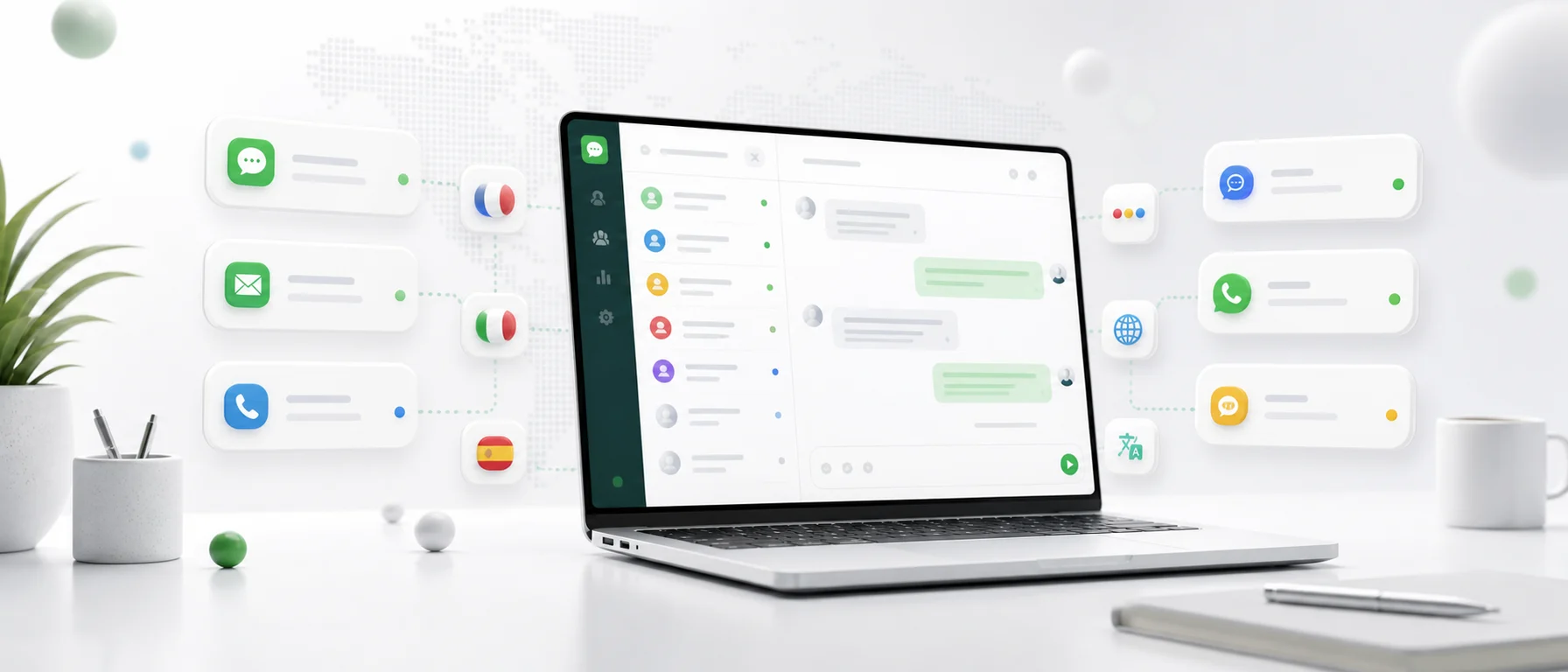
Chataptor helps companies collect customer messages in one place. A team can handle conversations from website chat, Facebook, Instagram, WhatsApp, email, marketplaces and ecommerce channels without constantly switching between apps.
Chataptor also supports automatic message translation. The customer can write in their own language, the agent can read and reply in the team’s language, and the customer receives the answer in their language.
Message templates and slash commands help with repeated questions about delivery, payments, returns, invoices or order status. The team prepares the answer once and inserts it faster during daily work.
Chataptor is 100% free, with no limits and no paid features. You can add free live chat to your website, organize conversations and see how much work one inbox and AI translations can simplify.
Checklist before selling to France, Italy and Spain
- Does the store explain delivery to France, Italy and Spain clearly?
- Can the customer see available payment methods before ordering?
- Are return rules understandable for international customers?
- Does the team have ready answers for delivery, payment and return questions?
- Do messages from different channels land in one inbox?
- Can the team read messages in its own language when customers write in French, Italian or Spanish?
- Is conversation history visible to the next teammate?
- Is it clear who answers international questions?
- Are templates updated when new questions repeat?
If several answers are “no”, the issue is not necessarily team size. Often it is the lack of a process and a tool that brings communication into one place.
FAQ
How can we support international customers without knowing the language?
Use a tool with automatic conversation translation. The customer writes in their language, the agent sees the message in the team’s language, replies normally, and the customer receives the answer in their own language.
Can one team support France, Italy and Spain?
Yes, if it has clear procedures, ready answers and a tool that collects messages in one inbox and translates conversations.
What questions do international ecommerce customers ask most often?
They usually ask about delivery, order status, shipping costs, payments, returns, exchanges, invoices, complaints and product availability.
Does live chat with translation help international sales?
Yes. The customer can quickly ask in their language, and the team can answer without manually copying messages into an external translator.
Is Chataptor free?
Yes. Chataptor is 100% free, with no limits and no paid features.
Summary
Selling to France, Italy and Spain does not require a large multilingual support department from day one. The most important things are a clear process, one place for messages and automatic translation support.
Customers want to ask in their language and receive a clear answer. The company wants to handle that conversation quickly, without chaos and without manual copy-paste between tools. Those needs can work together. If you plan to enter new markets, you can start with Chataptor for free and organize communication before message volume grows.
Keep reading
Related guides
How to support international customers when you do not know the language
A practical guide to answering international customers without speaking their language: process, examples, response templates and AI translation workflow.
How to support an online store in 20 languages from one inbox
Learn how to prepare customer support for a multilingual online store. One inbox, automatic translations, response templates and the BROWIN example.
The most expensive customer message is the one no one noticed
A missed customer message can mean a lost sale, complaint or relationship. See why messages disappear and how a shared inbox helps prevent it.