






Translating an online store into several languages can open a company to new markets. A product that was previously visible mainly to customers in one country can start reaching buyers in Germany, France, Czechia, Spain, Italy and many other places.
That is a real opportunity, but it also creates a new support problem. More traffic and more orders usually mean more questions, and those questions no longer arrive in one language.
That is why multilingual ecommerce needs more than translated product pages. It needs a simple way to handle customer messages from different countries, domains and channels.
Store translation is only the first step
Many companies begin international expansion by translating product descriptions, categories, checkout, policies, FAQs and purchase messages. That matters because customers are more likely to order when they understand the product, delivery terms and buying process.
BROWIN faced a similar practical challenge when developing international sales. Once a store starts operating in many language versions, the potential reach grows. At the same time, one question becomes unavoidable:
How do we support customers if the team does not speak every language used by the store?
Copying every message into a translator can work for a few questions a week. At scale, it becomes slow, tiring and easy to get wrong.
What changes when a store has 20 languages?
A one-language store usually has a simpler support process. Messages arrive in predictable places, questions repeat and the team understands local delivery, returns and payment rules.
With many languages, new layers appear:
- customers write in German, French, Czech, Spanish, Italian and other languages,
- different domains or language versions have different context,
- delivery questions may need different answers for Germany, France and Czechia,
- messages arrive through live chat, email, social channels and phone,
- the team needs a consistent tone even when it does not speak the customer’s language.
This is not only a language problem. It is an operations problem.
Why one panel is better than separate inboxes
With several language versions, separate inboxes and panels quickly become inconvenient. One person checks the German website, someone else sees the French messages, website chat is separate and some questions arrive through social media.
In that setup, missing a message is easy. Answering without full context is even easier.
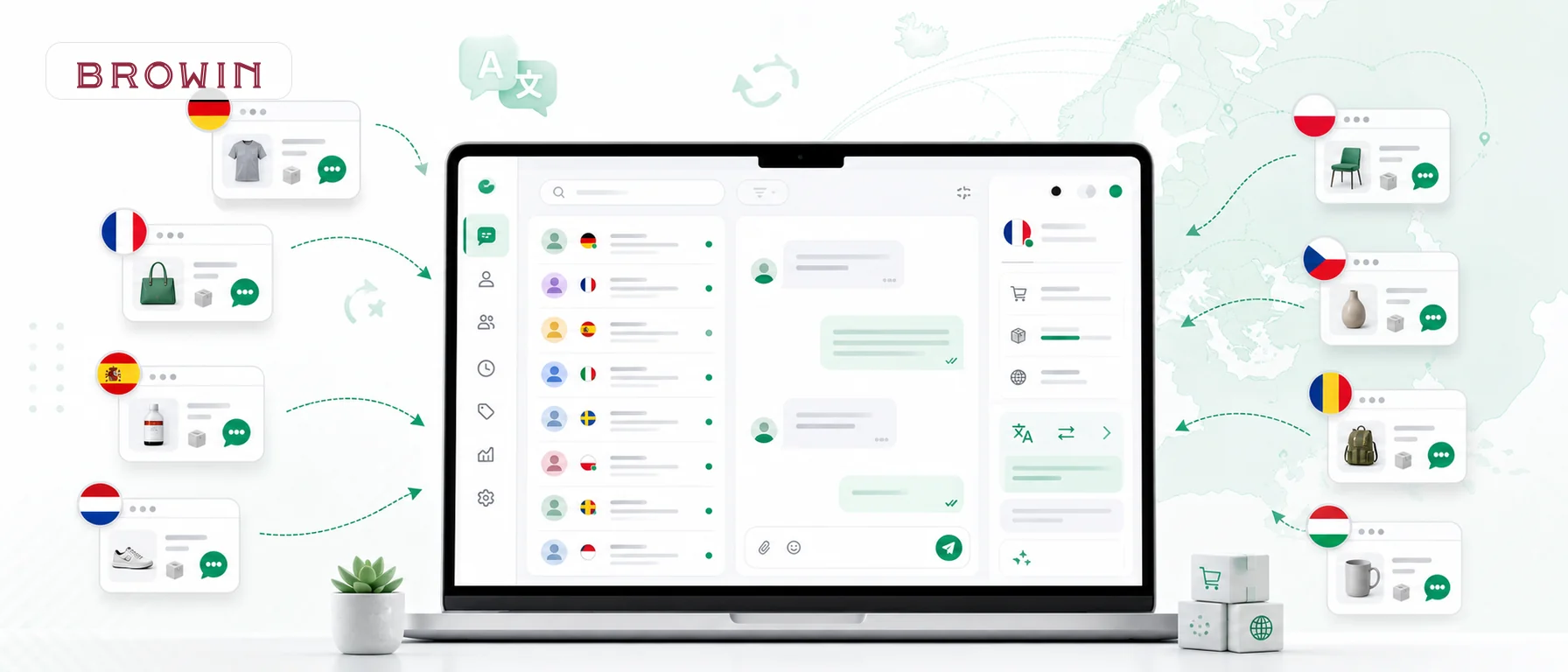
One customer support panel brings conversations into one place. The team can see new messages, the source of the conversation, contact history and assign cases faster. We explain the broader workflow in our guide to an omnichannel inbox for customer messages.
Automatic translations for international support
Language is the biggest barrier in multilingual customer support. Customers want to write naturally in their own language. The team wants to answer quickly without switching between tools all day.
In Chataptor, the workflow can be simple:
- the customer writes in their language,
- the agent sees the message in the team’s language,
- the agent replies normally,
- the customer receives the answer in their language.
This helps a company start supporting international questions without building a separate language team from day one. See also our guide to a website chat with automatic translation.
Response templates for different countries
In ecommerce, many questions repeat: delivery, order status, payment, invoice, return, complaint and product availability. For one market, one set of templates may be enough. For many countries, it is not.
Example: a customer from the German store asks about delivery cost. The agent types:
/deliveryThe system should suggest the answer for the German store, not a generic delivery message. The same command can insert a different answer for France, Czechia or Spain.
That saves time and reduces mistakes. If you are building a template base, read our guide to live chat canned responses.
Support from a phone
International questions may arrive at different hours. An owner, salesperson or ecommerce manager is not always sitting at a computer.
That is why mobile support matters. If a new message is visible only in a desktop panel, reacting outside the office becomes harder. Mobile access helps the team respond while the customer is still close to buying. We share more examples in the article about customer support from a phone.
How to prepare a store for multilingual support
Before launching more language versions, check not only the website content, but also the support process.
| Area | What to prepare |
|---|---|
| Translations | Products, checkout, FAQs, policies and purchase messages |
| SEO | Separate URLs and indexable language versions |
| Delivery | Clear terms for each country |
| Returns | Instructions customers can understand locally |
| Inbox | One place for messages from different store versions |
| Conversation translation | A way to answer in the customer’s language |
| Templates | Ready answers for common questions |
| Mobile | Ability to reply from a phone |
The worst scenario is investing in translations, gaining foreign traffic and then losing customers because communication is slow or chaotic.
Chataptor for multilingual ecommerce
Chataptor was created to organize customer communication from many markets. It can work as website live chat, but it becomes more valuable when a company wants one inbox for multiple channels, languages and teammates.
The key elements are:
- one panel for messages from different store versions,
- automatic conversation translations,
- response templates adjusted to pages and countries,
- mobile customer support,
- a simple start without a heavy help desk setup.
Chataptor is currently free, with no message limits and no paid features, so an online store can organize support without worrying that more conversations immediately create extra cost.
FAQ
Is translating the store enough to sell abroad?
No. Store translation is important, but the company also needs to prepare support for questions about delivery, returns, payments, complaints and products.
How can a team support customers without speaking many languages?
Use a tool with automatic conversation translation. Customers can write in their own language, while the team reads and replies in the language it uses every day.
Does one inbox make sense for several store domains?
Yes. The more domains, language versions and channels you have, the higher the risk of confusion. One inbox helps the team see all conversations and respond faster.
Can response templates differ by country?
Yes. It is worth preparing different answers for different markets, especially for delivery, returns, payments and fulfilment time.
Is Chataptor suitable for a multilingual online store?
Yes. Chataptor combines live chat, one inbox, automatic translations, message templates and mobile support, so it fits stores that serve customers in many countries.
Summary
A multilingual online store can open a much larger market, but translated pages alone are not enough. Customers will write in their own languages, from different domains and with different questions.
If you want to grow international sales without support chaos, prepare one inbox, automatic translations and templates for common questions. You can start with Chataptor for free and gradually organize support for more countries.
Keep reading
Related guides
The most expensive customer message is the one no one noticed
A missed customer message can mean a lost sale, complaint or relationship. See why messages disappear and how a shared inbox helps prevent it.
How to support international customers when you do not know the language
A practical guide to answering international customers without speaking their language: process, examples, response templates and AI translation workflow.
We translated 20 difficult customer messages. What can go wrong?
20 difficult customer messages that show where literal translation fails and how to write replies that AI can translate safely.