









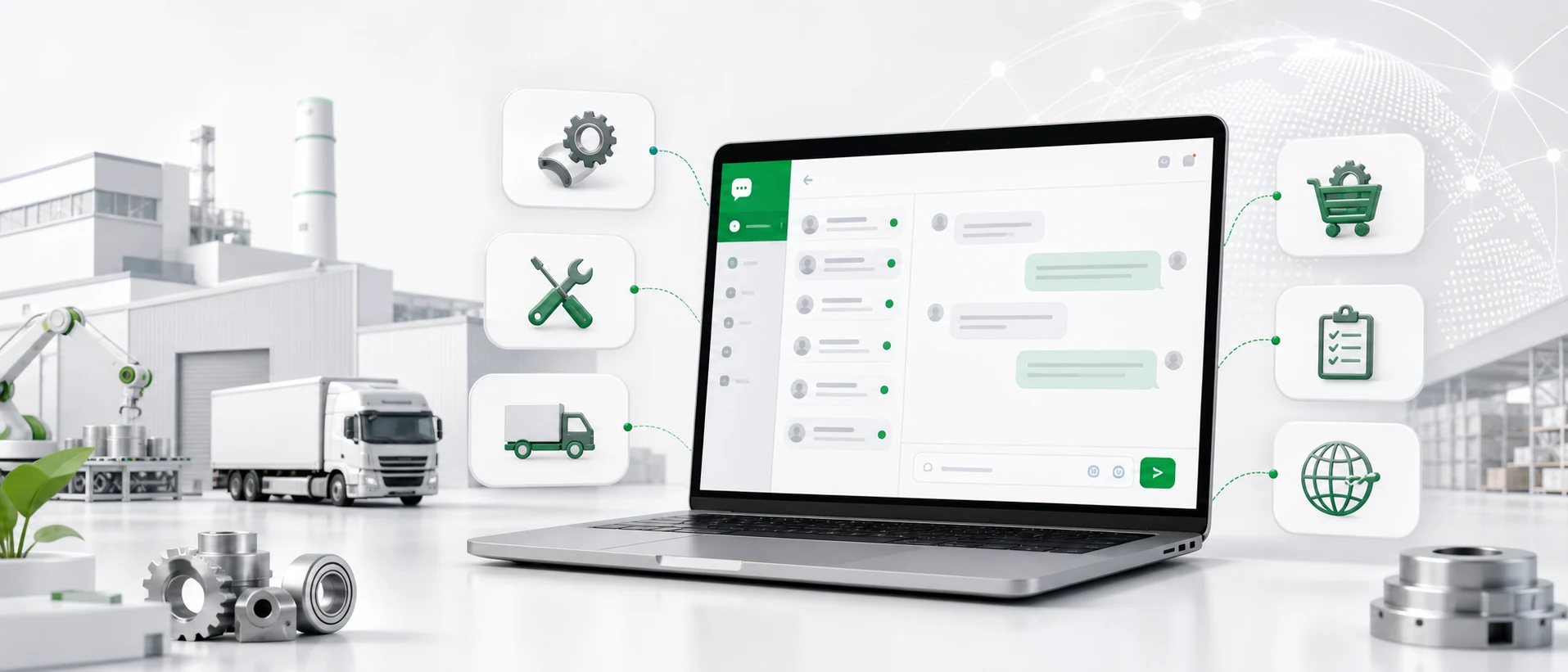
A manufacturing website is rarely visited only by people making a quick, low-value purchase. Visitors may be choosing a supplier for the next several years, preparing an RFQ, comparing technical parameters, checking custom manufacturing capabilities or deciding whether a company can deliver their project at all.
In that setting, one question can carry significant commercial value:
Can you manufacture this component in stainless steel?
We need approximately 20,000 units per year. Can you handle that volume?
Do you have a distributor in Germany?
Phone, email and contact forms still matter. Live chat for manufacturing adds a lower-friction option at the exact moment a buyer is reviewing the offer. Used well, it captures sales and technical enquiries, qualifies valuable leads and makes communication easier for customers, dealers and international partners.
What is website chat for manufacturing?
Website chat for manufacturing is a conversation channel embedded directly on a manufacturer’s website. Prospects and existing customers can use it to ask a practical question without leaving the product page or committing to a formal sales call.
The scope is much broader than a generic “How can I help?” Manufacturing conversations may include:
- requests for quotation and custom manufacturing enquiries;
- product specifications, standards and certifications;
- expected volumes and production capacity;
- lead times and product availability;
- technical documents and drawings;
- questions from dealers, distributors and integrators;
- logistics, export and delivery questions;
- spare parts, warranty and service requests;
- messages from buyers in other countries.
Not every case needs to be solved inside one chat. The immediate value is often simpler: turn an anonymous website visit into an identifiable conversation that sales, customer service or a technical specialist can continue.
Why does website chat for manufacturers make sense?
Many manufacturing websites still work primarily as catalogs. A buyer reviews products, downloads a PDF and checks the company’s capabilities. If one detail is missing, the visitor must navigate to a contact page and start a more formal process.
That buyer may not be ready to submit a complete RFQ or book a meeting. They may only need to confirm one requirement. If the answer is available, the manufacturer stays on the shortlist. If it is not, the buyer may open another supplier’s website.
Website chat for manufacturers fills the gap between independent research and a formal sales process. It also supports the broader role of B2B live chat in complex and high-value sales.
1. Capture RFQs while buyers are engaged
Requests for quotation are central to many manufacturing sales processes. A buyer may need a standard product, a custom variant, serial production, an OEM component, private-label manufacturing or a quote that includes transport.
The “Request a quote” form should remain. Live chat can enter the process earlier:
We need about 5,000 of these parts per month. Is that volume within your capacity?
If the answer is yes, the representative can request the specification and contact details, then pass a qualified case to the estimating team. Chat does not replace the quotation workflow. It starts that workflow while the buyer is actively considering the offer.
2. Answer technical questions accurately
Industrial purchasing rarely comes down to price alone. Buyers need to know whether a product fits a specific application. Their questions may cover:
- dimensions and tolerances;
- materials and operating temperature;
- output, pressure or voltage;
- standards and certifications;
- compatibility and installation;
- customization options.
Even a detailed product page cannot anticipate every use case. A person handling the chat does not need to know every answer, but they should never guess.
I want to confirm this with our technical team so I do not give you incorrect information. Could you share the equipment model and intended application?
A good manufacturing customer service chat records the right context and routes it to the right expert. For technical products, accuracy matters more than the appearance of an instant answer.
3. Support high-value manufacturing sales
The more expensive and complex a product is, the more questions appear before purchase. This applies to machinery, production lines, automation systems, specialized components, plant equipment and made-to-order products.
Someone buying a six-figure machine will not simply click “Add to cart.” The role of live chat for manufacturing sales is to move the buyer to the right next step:
- a sales conversation;
- a technical consultation;
- a document exchange;
- a prepared quote;
- a demonstration or factory visit.
One well-qualified conversation can be more meaningful than the total number of chats in a month.
4. Help buyers before they submit an RFQ
Before sending a formal enquiry, a buyer may spend considerable time checking machinery, materials, certifications, case studies, industries served, export experience and production capacity.
A single answer can determine whether the manufacturer reaches the shortlist:
Do you hold the certification required for automotive suppliers?
With live chat, the buyer can continue researching without interrupting the task and waiting for an email response.
5. Assist dealers and distributors
Not every visitor is an end customer. Dealers, distributors, wholesalers, installers and system integrators may be among a manufacturer’s most important audiences. They regularly ask about availability, current lead times, replacement models, technical documents and order status.
Manufacturing chat services can give partners a quick route for simple operational questions while leaving email for documents and formal agreements. This reduces unnecessary email threads and helps a distributor answer its own customer sooner.
6. Handle availability and production lead times
In manufacturing, a timing question may directly affect the purchase decision:
If we confirm this week, can the first batch of 2,000 units be ready by the end of the month?
The same applies to minimum order quantities, prototype times, production capacity, expedited runs and transport to a particular country.
A manufacturing support chat should capture the question and find its owner. If production planning needs to confirm the answer, say so and set a clear expectation. A chat does not have to be resolved instantly; the buyer needs to know that the message has been noticed and is moving forward.
7. Improve after-sales and technical support
The relationship does not end after a purchase. Customers may later need a spare part, manual, parameter, warranty detail, installation assistance or service contact.
An industrial chat service can collect the serial number, model and problem description before transferring the complete context to service or engineering. That is faster than sending the customer from department to department.
Product quality remains essential, but customers also judge a manufacturer by the help they receive when something needs attention after delivery.
8. Communicate with international buyers
A multilingual website solves only part of the problem. A German, French or Spanish buyer may read the offer in their language and still have a specific question about price, MOQ, shipping, documentation or warranty.
Chataptor automatically translates conversations across more than 100 languages using OpenAI and DeepL. The buyer writes in their language; the employee reads and replies in theirs. There is no need to copy each message into a separate translation tool. Read more about automatic translation in customer support.
For exporters, this kind of manufacturing live assistance makes it possible to test new markets without building a separate language team from day one.
9. Qualify better manufacturing leads
Live chat can collect useful context before a conversation reaches sales. After answering the buyer’s first question, the representative can naturally ask about the product, expected volume, available documentation, destination country and target date.
Instead of receiving “New website lead,” sales may receive:
A company in Germany is looking for an aluminum component supplier. Expected volume is around 10,000 units per month, drawings are ready and production should start in Q1.
That is far more actionable. The process should remain conversational, however. A visitor should not face a 15-question form disguised as a chat.
10. Connect sales, customer service and engineering
Manufacturing questions rarely arrive at the perfect department. A buyer may ask sales about a technical issue, while a distributor asks customer support about price. The organization behind the widget therefore matters as much as the widget itself.
Define:
- who owns new conversations;
- when a case moves to sales;
- when engineering or technical support is needed;
- who handles existing customers and service issues;
- how context is preserved during handoffs.
Chataptor brings live chat, email, WhatsApp, Facebook and Instagram into one workspace. An omnichannel inbox for customer messages lets the team continue a case without asking the buyer to explain everything again.
Manufacturing live chat services or a contact form?
Most manufacturers do not need to choose one. A form works well when the customer sends a detailed RFQ, attaches drawings, requests an official quotation or provides structured technical requirements.
Live chat is better when the buyer wants to confirm one fact, check feasibility, ask who owns the topic or determine whether preparing a full RFQ makes sense.
The practical model is: chat starts the conversation; a form or email takes over when formal documents are required.
Manufacturing chat assistance or a chatbot?
Automation can handle simple questions about opening hours, locations, basic documents and team availability. Manufacturing conversations quickly reach topics that require context and specialist knowledge.
AI is most useful when it assists an employee rather than creating another barrier between the buyer and the person who understands the product. An automated flow should always make it easy to reach a human.
What should a manufacturing live chat provider offer?
The best tool does not need unnecessary complexity. A practical manufacturing live chat provider should offer:
- fast notifications for new messages;
- multi-agent teamwork and clear ownership;
- conversation history and transfers;
- customer support from a phone;
- prepared live chat replies;
- clear online and offline hours;
- automatic translation for international customers;
- one inbox for multiple websites and channels.
Manufacturing live chat services do not need to operate 24/7. Outside business hours, the widget can collect a message and give a realistic response time. That is better than presenting an online status the team cannot support.
Common manufacturing chat enquiries
Preparing for common scenarios helps sales and support respond consistently.
Product question
Is this model suitable for a high-humidity environment?
Custom manufacturing question
Can you manufacture this part from our drawing?
Volume and pricing question
What is the minimum order quantity and indicative price for 5,000 units?
Lead-time question
What is your current production lead time?
Spare-parts question
We need a replacement part for equipment delivered in 2022.
International enquiry
Can you deliver to France?
Distributor enquiry
Is this product currently available, and when can it ship?
These examples show why manufacturing live chat services can connect sales, customer service and technical support instead of acting as a purely promotional widget.
Where should live chat appear on a manufacturing website?
The widget can be available across the site, with particular attention to high-intent pages:
- product and manufacturing-service pages;
- request-for-quote pages;
- technical documentation;
- industry-specific landing pages;
- export and distribution pages;
- the contact page.
It should be visible without covering important content. The guide to adding free live chat to a website explains the implementation process.
When does a live chat for industrial company websites work best?
Teams looking for live chat for industrial company websites should begin with clear responsibility. They need realistic response times, defined handoffs and access to specialists. Simply adding a widget without assigning an owner will not improve the customer experience.
It is also valuable when the company operates several websites, brands or language versions. Conversations can be organized by market, language, product or source while one team retains the full context.
Chat data can improve the manufacturing website
Conversation history shows exactly what buyers could not find. If many visitors ask about the minimum order quantity, US delivery or a particular certification, that information should become more visible on the page or in an FAQ.
The language used in manufacturing chat services is useful input for marketing, SEO, sales, product and customer service. It reveals how buyers describe their problems and what content the website should provide next.
Manufacturing live chat with Chataptor
Chataptor can serve as a free live chat and shared customer communication workspace for manufacturers. It includes:
- website live chat;
- a shared inbox;
- a mobile app;
- prepared replies;
- automatic message translation;
- support for multiple websites and language versions;
- additional communication channels in one place.
Chataptor is currently free, with no message or conversation limits and no features reserved for paid plans. A manufacturer can deploy it even when monthly enquiry volume is difficult to predict.
Is live chat for manufacturers worth it?
Yes, when potential customers visit the website before contacting sales. The key question is: what happens when a buyer needs one answer right now?
If the only options are a phone number and a form promising a later response, some valuable conversations never begin. Live chat gives the visitor a simpler third option: write now.
For products worth thousands or hundreds of thousands, a company does not need hundreds of conversations for the channel to pay off. A few relevant conversations may be enough.
Conclusion
Live chat for manufacturers can support RFQs, B2B sales, technical questions, dealer relationships, production lead times, spare parts, after-sales service and international communication.
Its earliest benefit is often the most important: the buyer is already on the website, evaluating the manufacturer and looking for an answer. Website chat lets that buyer start a real conversation without leaving the page.
Create a free Chataptor account and add live chat to your manufacturing website.
Frequently asked questions
What is live chat for manufacturing?
It is a website conversation channel that lets prospects and current customers ask about products, quotes, production, availability, documentation, delivery and technical support.
How does website chat for manufacturers support sales?
It captures buyers before they submit a formal RFQ and can lead to a technical consultation, sales call, document exchange or prepared quotation.
Can a manufacturing customer service chat support existing customers?
Yes. It can handle questions about current orders, documentation, spare parts, service, warranties and other after-sales topics.
Should a manufacturing support chat be staffed by engineers?
Not necessarily. Sales or customer service can receive the first message and transfer specialist questions to engineering with the full conversation context.
Can manufacturers use chat for dealers and distributors?
Yes. Partners can ask about availability, lead times, technical documents, replacements, parts and order status.
Does manufacturing live assistance work for international buyers?
Yes. Automatic translation lets buyers and employees write in the languages they use naturally while preserving the conversation in one place.
Does a manufacturing live chat service replace an RFQ form?
No. Chat is useful for initial questions, while forms and email remain better for detailed requirements, drawings and formal documentation.
What is the difference between manufacturing chat services and a chatbot?
Chat services connect a buyer with the team and preserve context. A chatbot can answer simple questions or route a case, but complex technical enquiries still benefit from a person.
What should teams seeking live chat for manufacturer websites look for?
A practical tool should provide fast notifications, mobile access, conversation history, teamwork, prepared replies, clear availability and automatic translation.
Is an industrial chat service required to run 24/7?
No. The company can publish real working hours and collect messages outside them with a clear expected response time.
Is Chataptor free for manufacturing companies?
Yes. Chataptor is currently free, with no message or conversation limits and no paid feature tiers.
Keep reading
Related guides
B2B live chat: does it work for services and high-value products?
Does B2B live chat help sell services, software, machinery and high-value products? Learn how to capture leads and shorten the path to a sales conversation.
Live Chat for Website: How It Works, What to Choose and How to Add It
Looking for live chat for website use? Learn how website chat works, which features matter, how to install a widget and choose the right software.
Does live chat really increase sales? 7 situations where it matters most
Does live chat increase ecommerce sales? See 7 situations where a fast, useful answer can remove buying friction and support conversion.